
Most parents ask this question about two years later than they meant to. Your child should see a dentist by their first birthday. At Strobel Family Dental, Dr. Dirk Strobel has cared for Rexburg families for over 40 years. His DDS from Creighton University School of Dentistry backs every visit here. Dr. Heber Strobel adds a Louisiana State University degree and advanced restorative training.
Age three feels safer to most parents, and that instinct deserves a real answer. The visit at age one is short, gentle, and built around you holding your child. Start with our dental care for kids in Rexburg page to see what we offer children. For everyone else at home, our general dentistry hub covers the rest. Parents from Burton, Newdale, and Rigby ask us this same question every week.
What Age Should a Child First See a Dentist?
Your child should see a dentist by their first birthday. Six months after that first tooth appears works too, whichever comes first. The American Dental Association and the American Academy of Pediatrics agree on this. Your pediatrician may have mentioned it at a well baby checkup already. It is one of those rules almost nobody hears until later.
Here is why that timing matters more than it sounds. A tooth can begin to decay the very day it appears. Gums do not get cavities, but teeth certainly do. So the clock starts at that first tooth, not the first birthday party. That visit also gives you somewhere to call before anything hurts.
Why Do Most Parents Wait Until Age Three?
The average first dental visit in this country lands near age 2.6 years. Older guidance really did point toward age three for a long time. Plenty of parents also wait until a child can sit still and cooperate. That sounds like common sense, and it is the main reason for the delay.
An age one visit never asks your child to sit still. You hold your toddler, and the dentist takes a short look. Waiting is common here, and nobody is keeping score on it. Dr. Dirk Strobel would rather see your child early than fix something later. The next appointment matters far more than the last four years do.
What Actually Happens at a First Dental Visit at Age One?
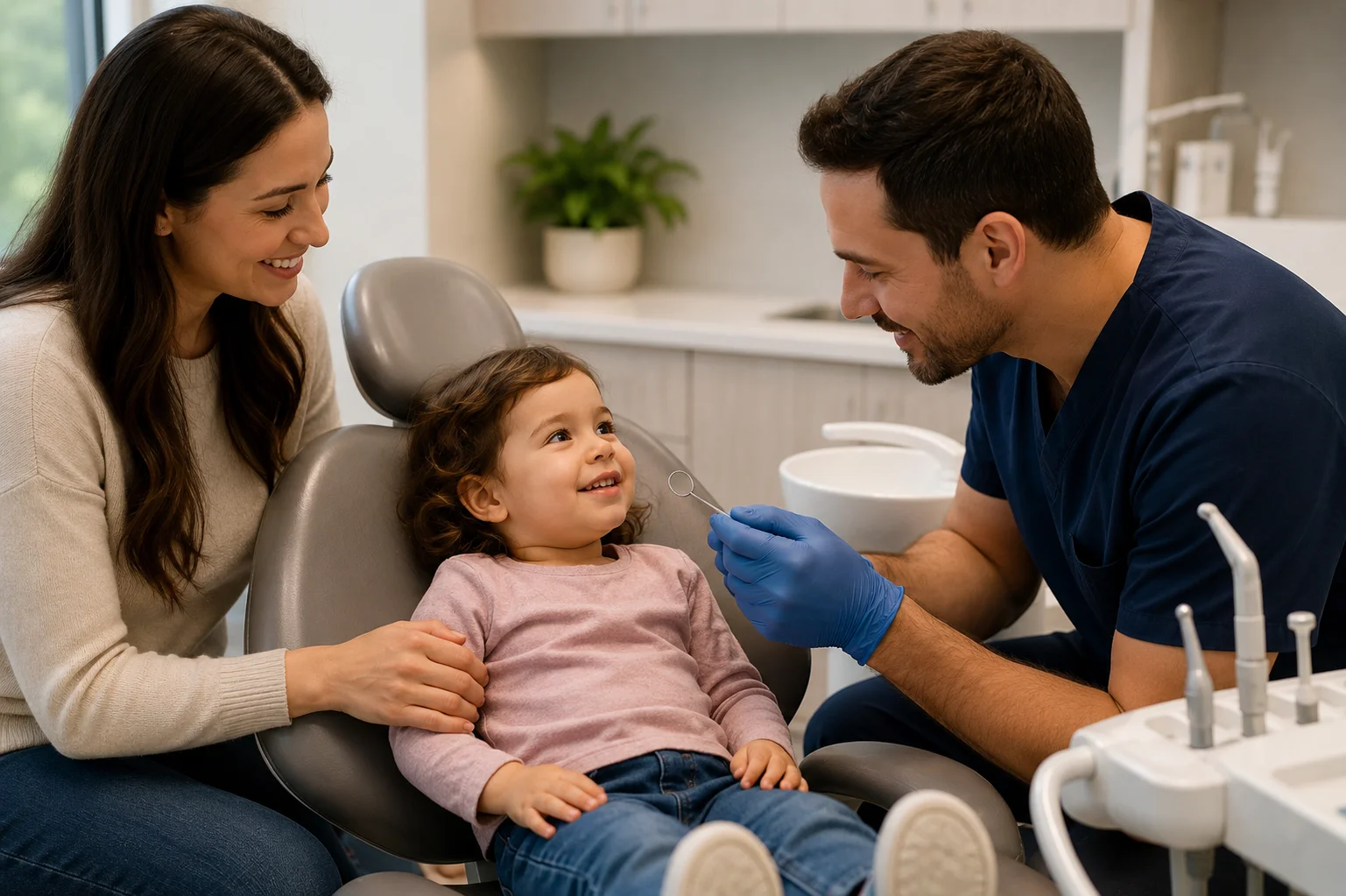
A first visit at age one takes a few minutes, not an hour. Your child sits on your lap and can see your face the whole time. The dentist checks how the teeth and jaw are coming in. There is no drilling that day, and there are no needles. Most visits are finished before a toddler decides to object.
Here is what that appointment usually looks like:
- Your child on your lap the whole time
- A short look rather than a long treatment
- A check on how teeth and jaw are developing
- A gentle cleaning of whatever teeth have arrived
- Fluoride painted on in a matter of seconds
- Coaching for you on brushing, bottles, and snacks
Crying and wiggling are normal, and every dental team here expects both. You never have to apologize for how your one year old behaves. Most of the useful information that day is aimed at you. You are the one brushing those little teeth twice a day for years. Bring your questions, because that is what the visit is really for.

Is Age One or Age Three Better for Your Child?
Age one is better for most children, though your family situation matters too. Both ages get real dental care, so neither visit is ever wasted. The difference is what the appointment is for when you walk in. One is an introduction, and the other often has catching up to do. The table below lays the two of them side by side.
| First visit at age 1 | First visit at age 3 | |
| Where your child sits | On your lap, facing you | Alone in the dental chair |
| How long it takes | A few minutes | A full appointment |
| What the dentist sees | First teeth and early jaw development | Three years of history at once |
| What you learn | Brushing, bottles, and snacks, early | The same coaching, years later |
| Likely finding | Nothing, or something caught very early | Whatever has had time to grow |
Neither column is a failure, and plenty of children start at three and do fine. The first column costs you about fifteen minutes on a normal Tuesday. The second asks a three year old to form an opinion during real treatment. Starting early also lets us watch how the jaw develops over time. Your own child may shift that timing in either direction.
What Happens If You Wait Until Age Three?
Waiting until age three changes what that first visit is for. An introduction turns into a repair when you spot a dark patch. Nobody plans it that way, and it happens to careful families too. Decay that started at eighteen months has had a long head start. Results vary from child to child, though the pattern repeats often.
For your child, the practical differences usually look like this:
- Decay found later has had longer to grow
- A small filling can turn into more involved work
- First memories form during discomfort, not during a friendly look
- Bedtime bottles and juice habits run unchecked for two more years
- Parents keep guessing about brushing and fluoride in the meantime
None of that means you should panic if your child is already five. It means the appointment you have not booked yet is the important one. Regular dental cleanings in Rexburg keep small problems small. The best visit is always the next one you can get on the calendar. Booking it this month costs you far less than waiting another year.
Where Can Rexburg Parents Take a One Year Old?
Strobel Family Dental has looked after Rexburg families since 1985. Dr. Dirk Strobel and Dr. Heber Strobel both see children as part of family dentistry. More than half of our patients now span two or three generations. Some parents bringing a toddler in were brought here themselves years ago. Nobody gets handed off to a different office across town.
That matters when you are running a household across the Upper Snake River Valley. One office handles a toddler exam, a fourth grader’s cleaning, and a grandparent’s crown. Saturday hours run from 7AM to 1PM, which often fits school and work best. Siblings of different ages can go in on the same trip. Our new patient page covers the forms and what to bring along.
Book the First Visit Before Anything Starts Hurting
You came here worried that you had already waited too long. Now you know what the visit involves and why age one matters. Dr. Dirk Strobel has given Rexburg families straight answers for over 40 years. Dr. Heber Strobel trained at Louisiana State University School of Dentistry. Both doctors built this practice on honest care and fair prices.
If your child has a tooth, then your child is ready today. If your child is already five, the right time is simply now. Nobody here will make you feel behind for booking it late. Call 208-356-4400 or visit strobelfamilydental.com to book that first visit. Families across the Upper Snake River Valley trust this team with their kids.
Frequently Asked Questions
Should a two year old go to the dentist?
Yes, and by age two that visit is running about a year late. A two year old usually gets the same short, low pressure appointment. Your child may still sit on your lap for the whole exam. The ADA advises a first visit no later than the first birthday, so booking soon is worth the trouble.
Do baby teeth really matter if they fall out anyway?
They matter more than most parents expect. Baby teeth handle chewing and speech while the adult teeth form underneath. They also hold the space those adult teeth need to come in straight. Losing one early to decay can crowd the teeth beside it, which is why baby teeth need real care.
My child is five and has never seen a dentist. Did I mess up?
No, and this happens far more often than the internet suggests. Families fall behind after a move, an insurance change, or a tight stretch. The visit you book this month does the same job it always would. Pediatricians recommend starting dental visits by the first birthday, and starting late still beats not starting.
Does a one year old really need fluoride?
Fluoride goes on as a varnish and takes only seconds to place. It strengthens new enamel while your child is at the highest risk. Your dentist sets the schedule around your own child’s risk factors. Cleveland Clinic notes that a first visit includes a check on whether fluoride is needed, then builds the plan from there.