
A kids dental cleaning in Rexburg runs about twenty minutes and covers five distinct steps. Dr. Dirk Strobel, DDS, trained at Creighton University School of Dentistry and has practiced in Rexburg for over 40 years. Dr. Heber Strobel, DDS, trained at Louisiana State University School of Dentistry. Below is the sequence, plus what the hygienist watches for at every step of it. The eastern Idaho numbers matter here too.
Most parents book the appointment without knowing what the twenty minutes contain. The worry underneath is simple. You’re afraid your kid will hate it. One bad visit turns into a decade of arguing about the dentist. Skipping cleanings carries a cost. Decay grows quietly on the chewing surfaces long before anybody feels a thing.
What happens during a kids dental cleaning?
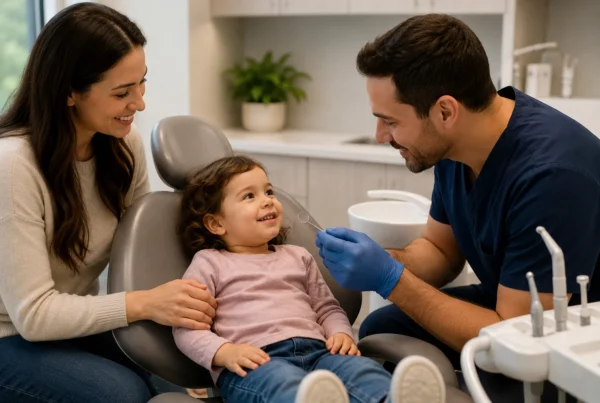
Five steps, in this order, every time. The hygienist reviews the mouth, removes plaque and tartar, polishes the crowns, flosses, then finishes with fluoride varnish. The whole sequence runs fifteen to twenty-five minutes for a child with no active decay.
The order matters as much as the parts do. Nothing touches enamel until the hygienist has looked over the teeth and gums first. Plaque and tartar come off next. The instrument depends on age, from a hand scaler to an ultrasonic tip to a soft polishing brush. The rubber cup and paste then smooth the surfaces so plaque has less to grip. Flossing clears the contact points, and varnish goes on last.
The American Academy of Pediatric Dentistry lists six purposes for a routine cleaning. Only two involve removing anything. The rest are about teaching technique, making the exam possible, and introducing a nervous child to dental instruments gently. Your child is learning the room as much as getting their teeth cleaned. That approach runs through all our kids dental care in Rexburg, start to finish.
What does the hygienist check before the polishing starts?
Plenty, and the review is why cleanings catch what brushing misses. Five checks happen before any instrument touches a tooth, and they take under two minutes. Each one shapes what the rest of the appointment looks like for your child.
- The gum line, for the swelling and bleeding that signal early gingivitis
- Chewing surfaces, for the chalky white spots that show up before a cavity does
- Contact points between teeth, where a toothbrush has never reached
- Which permanent teeth have erupted, since first molars arrive around age six
- Existing fillings and sealants, for chipped or worn edges
Eruption timing drives the whole plan for the year. A newly erupted molar has grooves that have never been cleaned and enamel that is still hardening. Those are the years a missed cleaning costs the most. The review also flags what is working at home. Plaque along one side of the mouth usually means your child brushes with one hand and rushes the other. A hygienist who spots it teaches the correction in ninety seconds. Our page on dental sealants in Rexburg covers what goes on those molars once they arrive.
Why do Rexburg kids need cleanings more than most of Idaho?
More than most of the state, and the gap is not small. Idaho third-graders showed a 65.6 percent rate of caries experience in the 2017 Smile Survey. In the Eastern Idaho Public Health District, which covers Madison County and Rexburg, that rate hit 77.1 percent. It was the highest of the seven districts.
| Measure, Idaho third-graders 2017 | Idaho statewide | Eastern District |
| Any decay experience | 65.6 percent | 77.1 percent |
| Severe decay, four or more teeth | 36.4 percent | 46.2 percent |
| Active untreated decay | 20.3 percent | 20.3 percent |
| Sealants on at least one molar | 67.2 percent | 70.4 percent |
| Needed urgent restorative care | 1.9 percent | 2.5 percent |
Severe decay tells the sharper story. Statewide, 36.4 percent of third-graders had four or more teeth with decay or fillings. Here it was 46.2 percent, close to half the class. Our kids get sealants at a slightly better rate than the state, and they still carry more decay. Sealants alone are not closing the gap here. Prevention has to start earlier than the permanent molars arrive, back when the baby teeth set the pattern.
Does a dental cleaning hurt a child?
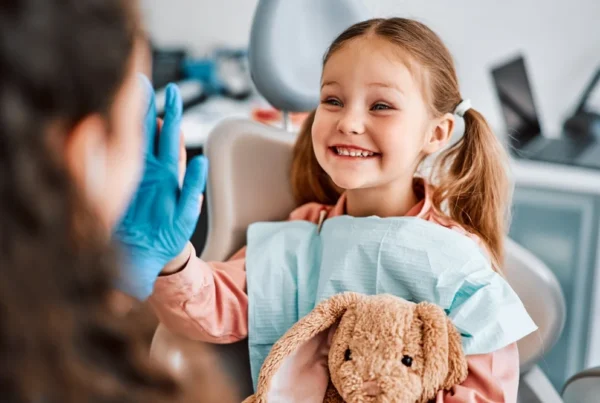
No, and that surprises parents who remember their own childhood visits. A routine cleaning on healthy gums involves pressure and vibration rather than pain. Only one of the five steps uses a sharp instrument. It never touches healthy enamel. The polishing cup tickles more than it hurts. Children with inflamed gums sometimes feel tenderness at the gum line.
That tenderness is information rather than a complication, and we say so out loud. Stress is a different question. One study measured salivary cortisol in children aged two to five. Levels rose during a routine cleaning, especially in kids with no previous dental treatment. That is worth knowing rather than dismissing. A calm pace and simple explanations do real work, which is why we move slowly with a first-timer.

How long does a kids dental cleaning take?
Fifteen to twenty-five minutes for the cleaning itself in most cases. Add the exam and the conversation with you afterward and the appointment runs closer to forty-five minutes. Book the whole hour. Nobody should feel rushed at the end of a first visit.
Age changes the number more than anything else. A three-year-old with eight teeth may finish in ten minutes. A twelve-year-old with a full permanent set, braces, and heavier tartar can run past thirty. Neither is a problem, and neither predicts how the next visit goes.
Time also stretches when the hygienist finds something worth a second look. A groove on a first molar means x-rays. That means a longer chair session and a real conversation about what comes next. Families driving in from Newdale or Rexburg East on University Boulevard should build in that margin. Our office on the map sits off Main Street, near the Madison School District 321 offices at 60 West Main.
What happens right after the cleaning is done?
Fluoride varnish, then instructions, then a plan for the next six months. The varnish is painted on and left alone, so your child eats soft food and skips brushing until that evening. Everything else that happens after the cleaning depends on what the exam turned up.
- Fluoride varnish stays on the teeth and should not be brushed off until the next morning
- Sealants get scheduled if a permanent molar has erupted and the grooves are deep
- X-rays follow if a chewing surface or a contact point looks suspicious
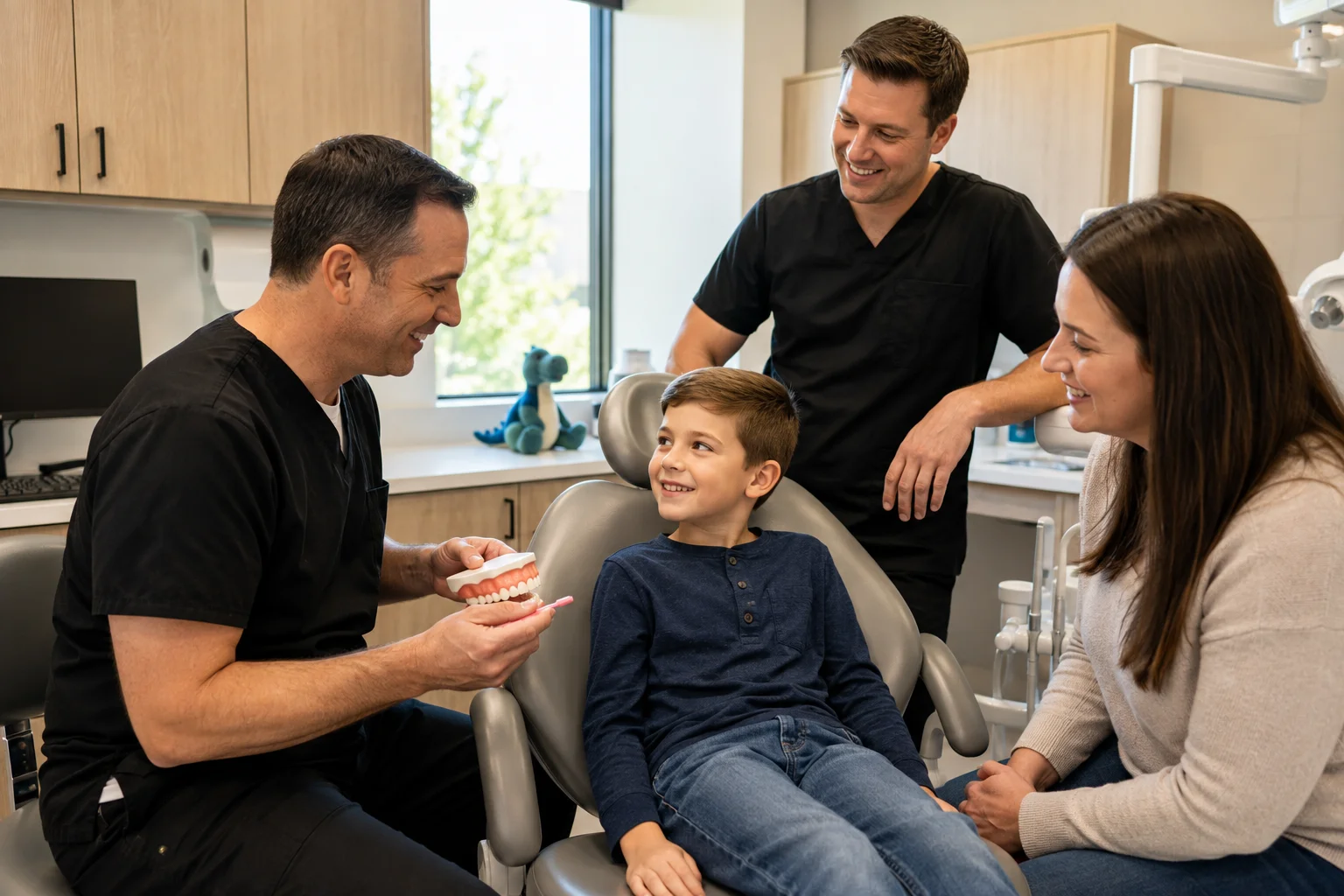
- Home technique corrections are demonstrated while your child is still in the chair
- The next appointment gets set before you leave, so the interval does not drift
The varnish step matters more here than most places. Federal data puts fluoride varnish at preventing roughly a third of cavities in baby teeth. Eastern Idaho decay rates say our kids need that margin. Our fluoride treatment page explains how the application works.
Your Child Leaves Knowing What a Clean Mouth Feels Like
Dr. Dirk Strobel, DDS, has cared for Rexburg families for over 40 years, and Dr. Heber Strobel, DDS, works alongside him. The visit follows the same shape every time. Your child gets a review, a cleaning, a polish, and varnish where it helps. You leave with a straight answer about what the exam found and what it means. Most parents want the same ending here. Their kid stops dreading the chair and starts brushing without a fight.
Call the office at (208) 356-4400 to book a cleaning, or schedule online if that is easier. Tell us your child’s age and whether it’s a first visit, so we set aside the right amount of time. We are open Saturdays from 7AM to 1PM for families who cannot miss a school day.
Frequently Asked Questions
Can I stay in the room during my child’s cleaning?
Yes, and for a first visit we usually prefer it. A parent in the room gives a young child a reference point. The hygienist can also show you the plaque pattern right there. The American Academy of Pediatric Dentistry frames caregiver instruction as one of the purposes of the appointment. Older kids often do better alone, and you can make that call year by year.
Should my child eat before a dental cleaning?
A light meal beforehand is better than an empty stomach or a big one. Hungry children get restless. A full stomach makes lying back uncomfortable, and anything sticky in the hour before gives the hygienist more to remove. The American Dental Association ties chewing-surface decay to what settles in those grooves. Water is fine right up until the appointment starts.
What if my child’s gums bleed during the cleaning?
Sometimes, and it usually means gingivitis at the gum line rather than anything the hygienist did wrong. Gums that bleed on gentle contact are inflamed, which happens when plaque sits along the margin for weeks. In most children the condition reverses with better brushing over two or three weeks. Research indexed by the National Library of Medicine treats bleeding on probing as a standard inflammation measure, not an injury.
Does my child get fluoride at the same visit?
Often, though not automatically at every visit. Varnish goes on when the risk picture calls for it. In this part of Idaho it usually does. The Centers for Disease Control and Prevention reports that fluoride varnish prevents about a third of cavities in baby teeth. We’ll tell you why we’re recommending it rather than adding it silently.