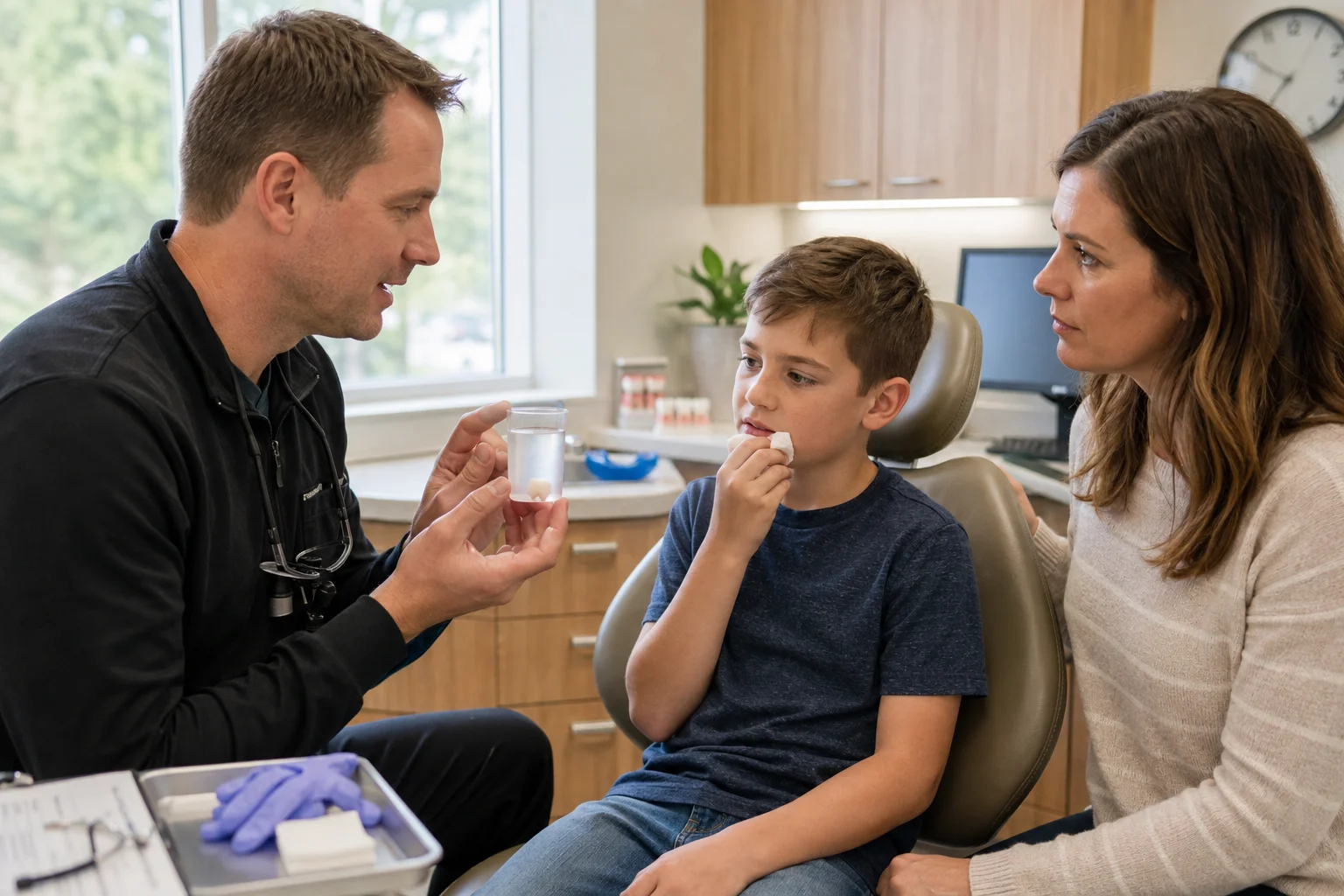

How long do you have to save a knocked out tooth? About 60 minutes, and the first five carry more weight than the rest of the hour combined. Where the tooth sits during those minutes changes the math. An hour is a threshold, not a door slamming shut. Dr. Dirk Strobel, DDS, trained at Creighton University School of Dentistry and has treated Rexburg injuries for over 40 years. Dr. Heber Strobel, DDS, trained at Louisiana State University School of Dentistry and handles the restorative work that follows.
Someone in your house is holding a tooth and watching a clock nobody’s explained. The fear is that every second you spend deciding is a second the tooth won’t get back. At stake is a natural tooth against decades of managing a replacement. Guessing wrong tonight narrows your options, and driving to the wrong building spends minutes you can’t buy back.
How long do you really have to save a knocked out tooth?
About 60 minutes of dry time is the working limit. Replant it inside five minutes and the odds sit at their highest. Between five and 60 minutes it still does well, provided you stored it correctly. Past 60 minutes of dry time the root cells are gone, though replanting remains worth doing for other reasons.
One five-year review followed 62 replanted permanent teeth through to their outcomes. Twenty-five went back in within the hour. Sixteen of those were still in the socket five years later. Of the 31 teeth eventually lost, 22 had been out longer than an hour. That split is the largest single effect in the data. Results vary with every injury.
Dry time is the number that matters, not total time on the clock. A tooth in cold milk for 40 minutes has almost nothing on the dry clock. The same tooth in a paper napkin has spent all 40. Our page on whether a knocked out tooth can be saved covers the survival odds in full. Emergency dental care in Rexburg is one phone call away.
What happens to the tooth in the first 30 minutes?
The root of every tooth wears a coat of living cells called the periodontal ligament. Those cells knit the tooth back to bone once it goes home. They start dying the moment air reaches them, and that damage only runs one direction. Irreversible damage sets in between 30 and 60 minutes. Speed protects those cells.
- Pick the tooth up by the crown and never by the root
- Rinse debris away with milk or saline, and never scrub the surface
- Slide it back into the socket if the person is calm enough to hold it
- Have them bite gently on a clean cloth to keep it seated on the drive
- Call the office from the car instead of waiting until you arrive
A parent who reseats the tooth in the driveway has done more than any dentist can do later on. Putting the tooth back at the scene beats every storage medium ever tested. The socket keeps those cells warm, wet, and fed. Our guide on what to do when a permanent tooth is knocked out walks the steps in order. Read it first if the fall happened minutes ago.
Does milk buy you more time?
Yes. Storage is your second lever after speed. The distance between the best choice and the worst gets measured in hours. Cold milk holds root cells alive for roughly six hours, which is longer than most families would guess. Tap water damages them faster than leaving the tooth in open air.
| Where the tooth sits | Roughly how long root cells stay viable | What this means |
| Back in the socket | Best available option | Nothing outperforms the socket |
| Balanced salt kit, HBSS | Up to 24 hours | Sold with an ADA Seal |
| Cold milk | Up to 6 hours | Lower fat performs better |
| Inside the cheek | 30 to 60 minutes | Not for small children |
| Dry napkin or tissue | Under 15 minutes | Drying is the fastest damage |
| Tap water | Worse than dry air | Cells rupture on contact |
Temperature matters as much as the liquid you choose. A carton pulled from the refrigerator outperforms milk that has been sitting on a counter. When nothing else is in reach, saliva beats air, so tuck it in the cheek. A clean cup with a lid beats a sandwich bag. No medium replaces getting to a chair, and results vary from case to case.
What if more than an hour has already passed?
Replanting still happens after 60 minutes, and what it aims for changes rather than disappears. The 2020 International Association of Dental Traumatology guidelines direct dentists to replant even past an hour of dry time. A tooth in that situation fuses to bone instead of reattaching. Dentists call that ankylosis.
- Holds the socket bone open so the ridge does not collapse inward
- Keeps the neighboring teeth from drifting into an empty gap
- Buys years of normal chewing, normal speech, and a normal smile
- Preserves ridge shape for an implant or a bridge later on
- Gives a growing child time before anyone commits to a permanent plan
Your choice is rarely between a perfect tooth and nothing at all. In a jaw that is still growing, a fused tooth stops moving while the bone around it keeps developing. That trade belongs in a conversation with us, not a decision you make alone. Outcomes vary from patient to patient, and the same dry time produces different results in a 9-year-old and a 40-year-old.

Should you drive to the ER or to a dentist?
Call us first. Emergency rooms handle pain, infection, and imaging well, then refer the replanting out to a dentist. That referral spends the exact minutes your tooth doesn’t have. One survey of 150 emergency physicians found 45.9 percent had no prior knowledge of avulsion. Another 42.6 percent did not know that extra-oral time mattered at all.
A head injury flips that order completely. Vomiting, confusion, or any loss of consciousness sends you to Madison Memorial Hospital first. The tooth rides along in a cup of milk. The hospital stabilizes the person while the tooth waits in the cup. You don’t have to choose between the two.
[BLOCKED SECTION. Owner: Mike. Outstanding item: one first-party observation from Dr. Dirk Strobel or Dr. Heber Strobel about avulsion cases the practice has handled. What arrives dry versus in milk, or what parents most often get wrong on the drive in. This is the Experience leg of E-E-A-T under Section 13 and its absence is a named validation FAIL. Insert as a two-sentence paragraph at the end of this section. Adds roughly 35 words, bringing the page to about 1,475 against a 1,500 ceiling. No other section changes.]
How does the window work if you live outside Rexburg?
Distance eats the window before anyone touches the tooth. Families in Edmonds and Hibbard reach us in a few minutes. Families driving South Yellowstone Highway from Rigby or Sugar City spend a real piece of the hour in traffic. The clock does not pause for the drive.
That drive is why your storage decision carries more weight out there than it does in town. A tooth traveling in cold milk from St. Anthony arrives with most of its window still open. The same tooth wrapped in a dry napkin arrives past saving. Milk sits in almost every refrigerator, which makes it the practical pick on a farm road. One decision at the kitchen counter settles which of those two versions arrives at our door.
An injury near Porter Park or in Rexburg South puts you close enough to reposition and drive straight in. Farther out, stabilize it first and call from the road so we’ve got the room ready. Our office on the map is easy to find once you turn off the highway. We are open Saturdays from 7AM to 1PM, so a Friday evening fall doesn’t wait out the weekend.
You Have More Window Than the Panic Suggests
Dr. Dirk Strobel, DDS, has treated Rexburg dental injuries for over 40 years, and Dr. Heber Strobel, DDS, handles the restorative work afterward. The plan holds steady. You call, and you bring the tooth however it traveled. We numb the area, clean the socket, seat the tooth, and confirm the position on an x-ray. A flexible splint goes on before you leave, and you leave knowing where you stand. Most families want one ending. Their kid eats normally and doesn’t think about the tooth anymore.
Call the office at (208) 356-4400 and say a tooth has been knocked out. Once the tooth is stored and safe, you can also book online. Bring the tooth either way, along with any fragment you picked up off the ground.
Frequently Asked Questions
How long can a knocked out tooth stay out of the mouth?
Under 60 minutes of dry time is the strongest window. The American Association of Endodontists notes a tooth out for an hour or more can still be saved. Past the hour the kind of healing changes, not whether it’s worth trying. Store it in milk and bring it in even at the four-hour mark.
Can I put a knocked out tooth back in myself?
Yes, and it’s the most useful thing you can do. Hold the crown, line the tooth up with its neighbors, and press it in with steady pressure. Cleveland Clinic puts replantation at the scene ahead of the phone call. Store it in milk if it won’t seat. Forcing a tooth into a damaged socket does more harm than waiting for us.
Is it too late to save a tooth after 24 hours?
Rarely, though one report describes a tooth replanted after 30 hours that survived five years. Late replanting sits directly in the 2020 IADT avulsion guidelines. Expect fusion to bone instead of a true ligament reattachment, which limits what comes later. It still holds bone for years.
Does the window work the same way for a baby tooth?
Yes, and the answer reverses. A baby tooth doesn’t go back in, because pushing it risks the permanent tooth developing above it. Guidance indexed by the National Library of Medicine is blunt on this point. Bring your child in within a day anyway, so we can check for root fragments and watch the spacing.