

Both are removable dentures, and the difference is what holds them. A traditional denture rests on your gums. An implant denture snaps onto two or more posts set in the jaw. Dr. Heber Strobel, DDS, trained at Louisiana State University School of Dentistry and has placed over 70 implants in Rexburg. Dr. Dirk Strobel, DDS, trained at Creighton University School of Dentistry. Below is how the two compare on holding power, bone, upkeep, and what daily life looks like with each.
If you wear a lower denture now, you already know the problem. It lifts when you chew, and you’ve quietly stopped ordering certain things in restaurants. The fear is spending thousands and still ending up with something that moves at dinner. What’s at stake is years of eating around your teeth instead of with them.
What is the difference between the two?
Attachment, and everything else follows from it. A traditional denture stays put through suction, gum contact, and often a strip of adhesive. An implant denture clips onto posts anchored down in the bone itself. Both come out at night, which surprises people who assume implant dentures are fixed. Neither one is bolted in.
The clinical name for the second one is an overdenture. It’s still a denture, and it still lifts out for cleaning. What changes is that it comes out when you decide, not when a cracker decides for you. Our implant-supported dentures page covers how the posts get placed and what healing looks like.
That distinction matters, because the two get sold as different categories entirely. They’re the same appliance with a different anchor. A patient who dreads surgery and one who dreads a slipping plate are arguing about the same few millimeters.
How does each one stay in your mouth?
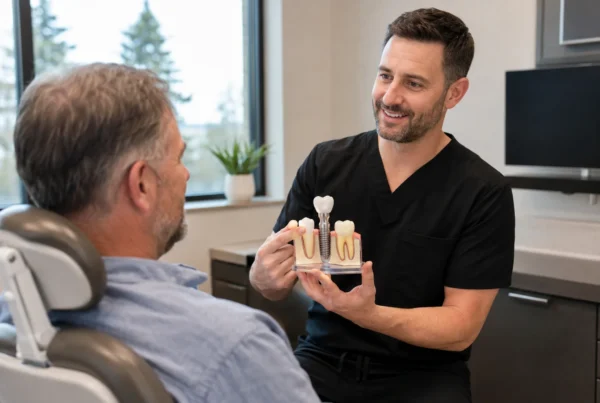
Two implants is the documented minimum for a lower denture, and the number rises from there. How firmly it holds depends on which attachment sits between the post and the plate. Each option trades retention against maintenance, and none of them is permanent hardware.
- Suction and gum contact alone, which is how every traditional full denture works
- Ball attachments, where a rounded post clicks into a socket in the denture base
- Locator style attachments, which use a nylon insert that wears and gets swapped
- A bar splinting two or more implants, with clips on the underside of the denture
- Four or more implants for an upper denture, which needs more anchorage than a lower
The nylon inserts are the part nobody mentions upfront. They wear on a schedule, usually once or twice a year depending on how hard you chew. That is maintenance rather than failure. It is worth knowing before you sign anything, because nobody volunteers it. Swapping one is a quick visit rather than a repair. The cost sits closer to a cleaning than to surgery.
How do they compare side by side?
Side by side, the gap is widest on holding power. It narrows almost to nothing on daily routine. One clinical comparison scored patient satisfaction at 6.6 out of 10 for conventional dentures and 8.7 for implant overdentures. Comfort, stability, and chewing all separated the same way in that trial.
| Traditional denture | Implant-supported denture | |
| What holds it | Suction, gum contact, adhesive | Two or more implants in the jaw |
| Surgery required | None | Yes, plus healing time |
| Comes out at night | Yes | Yes |
| Reported satisfaction | 6.6 of 10 in one comparison | 8.7 of 10 in the same study |
| Effect on jawbone | Resorption continues underneath | Reduces resorption in the lower jaw |
| Ongoing upkeep | Relines as the ridge shrinks | Attachment inserts replaced, plus relines |
| Strongest evidence | Both arches | The lower jaw specifically |
Satisfaction is not the same thing as suitability. A traditional denture that fits a well-shaped upper ridge works well. Plenty of our patients are happy with one. The numbers describe averages. Outcomes vary from patient to patient, and a good conventional fit beats a poorly planned implant case.
Which one is better for your jawbone?
The implant denture, and the difference here is measurable rather than theoretical. Bone under a traditional denture keeps shrinking because nothing loads it from above. After extraction a ridge loses much of its original height, then continues resorbing roughly 0.5 to 1.0 millimeters a year.
That’s why a lower denture that fit well in year one rocks by year six. The ridge underneath has changed shape while the plate has not. Implants slow that process in the lower jaw. They transmit chewing force into bone the way a natural root does. A traditional denture can be relined to keep pace. Relining chases the shrinkage rather than stopping it, which is why the visits keep coming.

Is an implant denture always the better choice?
No, and the honest answer runs against how this gets marketed. The evidence for implant overdentures is strongest in the lower jaw, where a conventional denture has the least to grip. Two consensus statements, McGill in 2002 and York in 2009, moved the lower jaw off conventional dentures as the default.
The upper jaw is a different picture. An upper denture already gets suction across the palate, so it holds better without help. The lower jaw has no palate to grip. Published outcome data puts maxillary implant overdentures among the highest failure rates of any prosthesis type. One widely cited review reported more than one in five.
That doesn’t rule the upper arch out, and plenty of upper overdentures work well. It does mean the case has to be made, not assumed. If someone recommends implants for both arches without explaining why the upper one is different, ask them to. A straight answer should be easy to give. Our comparison of implants, dentures, and bridges covers the wider set of options.
What does daily life look like with each?
Closer than the sales pitch suggests, with the differences showing up at meals and at the sink. Both come out at night, and both get brushed outside the mouth. The daily routine separates on how much you think about the appliance while you are wearing it.
- Traditional dentures often need adhesive, and reapplying it is part of the morning
- Implant dentures snap in and stay, so adhesive usually comes out of the routine
- Both get cleaned outside the mouth, and neither goes back in dry overnight
- Implant posts need brushing around the gum line, the same as natural teeth would
- Sore spots from a shifting plate tend to fade once the denture stops sliding
The eating difference is the one patients mention first, usually before comfort or looks. Foods that come back are apples, corn, and steak, the three a lower denture makes awkward. Results vary, and nobody should promise you a menu. Patients drive to us from St. Anthony and Rigby, and most come in down Main Street past Madison Memorial Hospital. Our office on the map sits a few minutes off that route. That matters when adjustment visits run through the first year.
You Find Out Whether Implants Would Change Anything for You
Dr. Heber Strobel, DDS, places and restores both, and Dr. Dirk Strobel, DDS, has cared for Rexburg families for over 40 years. The evaluation comes before the recommendation. Every time. We look at your ridge, your bone height, and what your current denture is doing to the tissue underneath. You get a straight answer about whether implants would change anything for you, including when we think they would not.
Call the office at (208) 356-4400 to talk it through, or schedule online if that is easier. Bring your current denture if you have one, since how it wears tells us more than a photo can. Nothing about that visit commits you to anything.
Questions Rexburg patients ask about implant dentures
Can my current denture be converted to snap onto implants?
Usually yes, and converting an existing denture is common. Your current plate can often be modified to accept attachments once the implants have healed. Whether that works depends on the condition of the denture and how much your ridge has already changed shape. Cleveland Clinic describes the overdenture itself as a part that gets replaced periodically, separate from the implants.
Do implant-supported dentures still come out at night?
Yes, and that’s by design rather than a limitation. An implant-supported denture unclips so you can clean it and the tissue underneath properly. Leaving it in overnight traps plaque against the gum and around the posts. Research indexed by the National Library of Medicine notes that retention hardware collects biofilm when hygiene routines slip.
Does an implant denture stop bone loss completely?
Less than a traditional lower denture does, though not zero. The plate still rests partly on tissue, so some pressure reaches the ridge behind the implants. A systematic review in the International Journal of Implant Dentistry found load moving toward the back of the ridge. Regular checks catch that shift before it changes the fit or the comfort.
How many implants does a denture need?
Two is the documented minimum for a lower denture. More than two is common, and four is typical up top. The McGill and York consensus reviews treat two implants as sufficient for most people rather than ideal for everyone. Upper dentures generally need four or more because the bone is softer. Your own number comes out of the exam and the imaging.